Le EU Tax Observatory mène des recherches innovantes sur la fiscalité, en mettant l'accent sur la fiscalité des entreprises, l'évasion fiscale, la fraude fiscale et les solutions à ces problèmes.
This policy note summarizes the conclusions of several working papers written by researchers from the EU Tax Observatory and colleagues. It provides an overview of the progress and shortfalls of the reform known as the Common Reporting Standard (CRS), a decade after its introduction.
Using firm-level data for France in 2018, the paper provides the first joint quantification of the three main profit-shifting channels: transfer mispricing in goods trade, intangible assets and services traded with tax havens, and intra-firm debt.
Par
Javier Garcia-Bernardo, Petr Janský, and Gabriel Zucman
The 2017 Tax Cut and Jobs Act lowered the US corporate tax rate and introduced provisions to curb profit shifting. The paper combines survey data, tax data, and firm financial statements to study the evolution of the geographical allocation of US firms’ profits after the reform.
Par
Souleymane Faye, Sarah Godar, Carolina Moura, and Gabriel Zucman
This paper constructs homogeneous time series of global household offshore wealth covering the 2001–2023 period, during which major international efforts were implemented to curb offshore tax evasion. We find that: (i) global offshore wealth remained broadly stable as a fraction of global GDP since
Par
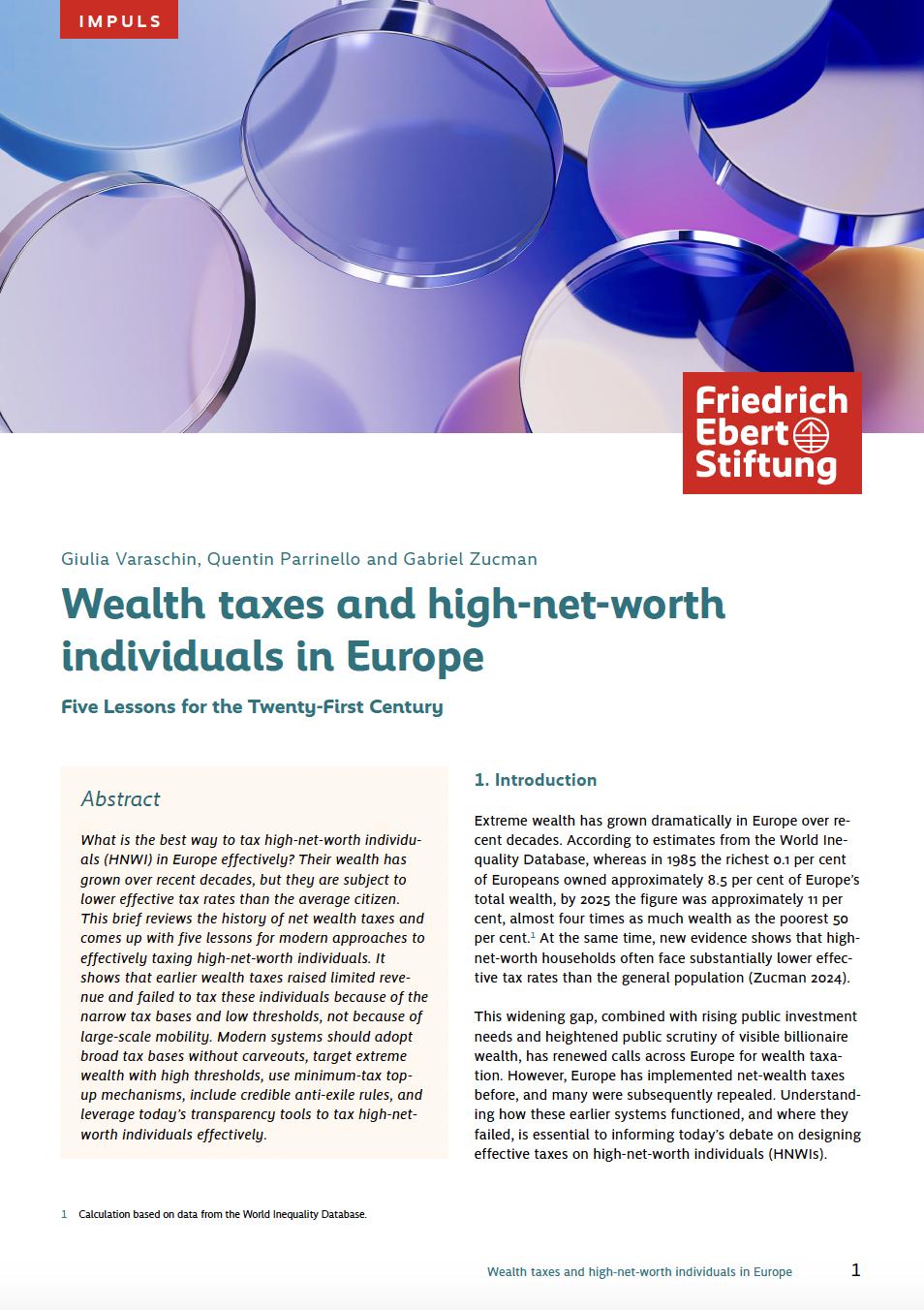
Giulia Varaschin, Quentin Parrinello, and Gabriel Zucman
This brief reviews the history of net wealth taxes and comes up with five lessons for modern approaches to effectively taxing high-net-worth individuals.
The paper studies post-Apartheid inequality dynamics in South Africa using a new microdatabase that combines survey, tax, national accounts, and budget data from 1993 to 2019.
Par
Alice Chiocchetti, Manon François, Laure Heidmann, and Giulia Aliprandi
Cette étude quantifie comment la délocalisation de profits érode les revenus des travailleurs en réduisant les versements de participation au sein des multinationales françaises.
This paper studies the enforcement of new due diligence policies, which constrain firms to curb foreign sourcing linked to human rights violations through transparency and reporting.
This policy note highlights key results of the Working Paper entitled “No blood in my mobile: regulating foreign suppliers” (2025) by EU Tax Observatory researcher Ninon Moreau-Kastler.
Par
Lorenzo Garlanda-Longueville, Mathias Lé, and Kevin Parra Ramirez
This paper finds that the location of cross-border intra-group debt held by multinational banks is shaped by tax considerations, even when regulatory differences are taken into account.
Par
Theo Palomo, Davi Bhering, Thiago Scot, Pierre Bachas, Luciana Barcarolo, Celso Campos, Javier Feinmann, Leonardo Moreira, and Gabriel Zucman
The paper uses population-wide administrative micro-data to provide new estimates of income inequality and effective tax rates by income groups in Brazil, capturing all income and all tax payments.
Par
Sarah Clifford, Jakob Miethe, and Camille Semelet
This paper characterizes profit shifting behavior across the size distribution of multinational enterprises (MNEs) to evaluate the targeting of the recently introduced Global Minimum Tax (GMT).
Over the past decade, more than 100 jurisdictions have signed AEoI in an effort to fight cross-border tax evasion. This paper studies the effectiveness and coverage of these agreements using account data leaked from an Isle of Man bank with a large customer base in countries participating to AEoI.
This report examines the evolution of harmful corporate tax practices in recent years, as well as the development of blacklists intended to identify such practices.
Par
Hjalte Fejerskov Boas, Matthew Collin, Sarah Godar, Carolina Moura, and Andreas Økland
Our analysis reveals that the volume of data exchanged internationally has increased and improved substantially over recent years and that CRS-reported foreign wealth accounts for approximately 9% of household financial wealth.
Par
Annette Alstadsæter, Matthew Collin, and Andreas Økland
In this paper, we (i) present the growing body of social science research that relies on leaked data, (ii) discuss the ethical, legal and privacy hurdles faced by projects relying on such data and (iii) offer a practical roadmap for researchers looking to enter the space.
The paper proposes a counterfactual approach to measure proportional treatment effects for staggered multiplicative difference-in-differences (DiD) models with Poisson Pseudo-Maximum Likelihood (PPML).
Par
Jules Ducept, Sarah Godar, and Quentin Parrinello
The effective tax rate of multinational companies declined by 2.7 percentage points in the European Union between 2014 and 2022, shows a new EU Tax Observatory analysis of a decade of corporate tax reforms. The decline was exacerbated by tax competition between Member States.
This paper documents the rise of corporate tax-base narrowing measures in the EU using a novel dataset covering both tax rate and tax base reforms implemented between 2014 and 2022.
Par
Carl Gaigné, Elsa Leromain, Riccardo Norbiato, Mathieu Parenti, and Giulia Varaschin
Preserving competitiveness does not require lowering environmental standards. Instead, well-designed policies can facilitate an alignment of both goals.
Cryptocurrencies pose substantial challenges to tax enforcement due to their anonymous and decentralized properties, undermining conventional regulatory practices. We study the impact of an ambitious new enforcement initiative aimed at addressing these challenges...
Par
Quentin Parrinello, Giulia Varaschin, and Gabriel Zucman
This policy note provides a revenue estimate of how much European Member States could raise with a minimum tax of 2% or 3% on the wealth of people owning more than €100 million or €1 billion in wealth – the scenarios considered in the report commissioned by the G20 presidency.
Par
Eva Davoine, Joseph Enguehard, and Igor Kolesnikov
The paper examines the political costs of taxation in early modern France. It focuses on efforts to enforce the salt tax, the rate of which varied across regions.
Par
Sónia Cabral, Joana Garcia, Raquel Miranda, Susana Peralta, and João Pereira dos Santos
This paper offers the first detailed characterization of the labor market in a tax paradise and the first assessment of how a reform aimed at discouraging tax avoidance affected workers.
Par
Tomáš Boukal, Petr Janský, and Miroslav Palanský
We develop a methodology to decompose the tax revenue impact of the global minimum tax introduced in 2024 into several components and quantify its potential impact on profit shifting.
Par
Alessandro Ferrari, Sébastien Laffitte, Mathieu Parenti, and Farid Toubal
We propose a model of corporate tax avoidance that separates profits generated by real economic activities from paper profits shifted to tax havens. The model introduces ’triangle identities’ to estimate bilateral profit-shifting flows.
Par
Hjalte Fejerskov Boas, Niels Johannesen, Claus Thustrup Kreiner, Lauge Larsen, and Gabriel Zucman
The working paper studies the effects of automatic information exchange on tax compliance by analyzing the universe of information reports sent by foreign banks to Danish authorities, matched to population-wide micro-data on income, wealth, and cross-border bank transfers.
The note estimates that approximately 50% of large US companies and a significant portion of multinationals from countries like China, Japan, and Germany will potentially have to disclose information on their tax haven presence.
Les systèmes fiscaux actuels ne parviennent pas à taxer efficacement les particuliers très fortunés. Ce rapport présente une proposition visant à résoudre ce problème par le biais de la coopération internationale.
Par
Matthew Collin, Karan Mishra, and Andreas Økland
This note addresses the significant concerns associated with anonymous real estate ownership in the United States, highlighting how a considerable amount of property, including residential real estate, is held via corporate entities that conceal the true owners.
This report examines the current landscape of corporate tax transparency and evaluates how emerging transparency measures could shape future developments in this critical area.
Par
Annette Alstadsæter, Matthew Collin, Bluebery Planterose, Gabriel Zucman, and Andreas Økland
This note presents new evidence on the scale of foreign investment in the Dubai residential property market. Using new data comprising the ownership of a large share of the Dubai property market, we present updated estimates of foreign-owned real estate for the years 2020 and 2022.
Par
João Pereira dos Santos, and Kristina Strohmaier
In this paper, we study the extent to which “golden visas” impact real estate housing markets. Using the population of transactions records from 2007 to 2019, we analyse the introduction of the Golden Visa Program in Portugal in 2012.
This paper investigates the determinants and consequences of the development of tax havens using a novel database that tracks the creation and development of offshore institutions in 48 tax havens.
Par
Jules Ducept, Evangelos Koumanakos, and Panayiotis Nicolaides
This working paper looks at the responses of corporations in the Greek Islands to an increase in the VAT rate from 16% to 24%. Declared profits decreased by 28% and corporate income taxes by 34%. Tax evasion opportunities offer a plausible explanation of the response.
Par
Annette Alstadsæter, Sarah Godar, Panayiotis Nicolaides, and Gabriel Zucman
An unprecedented research collaboration investigating the successes and failures of the fight against tax evasion over the last decade, building on the work of more than 100 researchers globally.
Par
Quentin Parrinello, Mona Barake, and Elvin Le Pouhaër
This note examines the impact of the recent introduction of minimum thresholds for the global implementation of the OECD/G20 Pillar One reform for key countries in the context of the negotiations.
Par
Kane Borders, Sofía Balladares Herbert, Mona Barake, and Enea Baselgia
Digital Service Taxes (DSTs) are a recently introduced fiscal tool designed to tax digital companies. This note collects all publicly available data to take stock of the first few years of DST implementation.
In this paper, we conduct a benchmark analysis focusing on publicly available Country-by-Country Reports to assess the reliability of CbCR information compared to respective consolidated financial information.
Par
Pierre Bachas, Anne Brockmeyer, Roel Dom, and Camille Semelet
This paper provides novel evidence on the relationship between firm size and effective corporate tax rates using full-population administrative tax data from 13 countries.
This paper presents simulations of the tax revenue arising from the Pillar One Amount A proposal of the G20/OECD Inclusive Framework on Base Erosion and Profit Shifting.
Like in many other countries, wealth inequality has increased in Switzerland over the last fifty years. By providing new evidence on cantonal top wealth shares for each of the 26 cantons since 1969, we show that the overall trend masks striking differences across cantons, both in levels and trends.
La déclaration pays par pays est une source de données clé pour comprendre les activités des multinationales. Cette note explore les rapports publics pays par pays publiés par les multinationales pour mettre en évidence plusieurs tendances importantes.
We collect, digitize, and supplement Swiss rich lists published in the “BILANZ” business magazine since 1989, to gain new insights on the structure and dynamics of top wealth in Switzerland.
Cet article explore l’optimisation fiscale des banques européennes à travers une nouvelle source de données. Depuis 2014, les institutions financières ont commencé à divulguer leur activité dans chaque pays, conformément à la directive européenne CRD IV.
This paper is the first to estimate the full extent of foreign-owned commercial and residential real estate in a country, including both direct and indirect ownership.
Cet article construit des séries temporelles de transfert de bénéfices mondiaux couvrant la période 2015-19, durant laquelle d'importants efforts internationaux ont été mis en œuvre pour freiner le transfert de bénéfices.
Par
Manon François, Carlos Oliveira, Bluebery Planterose, and Gabriel Zucman
Cette note présente une nouvelle façon d'imposer les bénéfices extraordinaires des entreprises ayant bénéficié de circonstances exceptionnelles depuis l'invasion de l'Ukraine, comme le secteur énergétique, en taxant la hausse de la capitalisation boursière de ces entreprises.
Ce document étudie l'efficacité des amnisties fiscales et leurs impacts sur l'imposition du capital et les dépenses publiques. Nous tirons parti de la grande variabilité des politiques de l'Argentine, qui a mis en œuvre le programme le plus réussi au monde, révélant des actifs d'une valeur de 21 %.
Par
Manon François, Bluebery Planterose, Gabriel Zucman, and Carlos Oliveira
This paper presents a new way to tax excess profits. We propose to tax the rise in the stock market capitalization of companies that benefit from extraordinary circumstances, such as energy firms following the invasion of Ukraine in February 2022.
Événement annuel de référence dans la lutte contre l'évasion fiscale, la conférence visait à faire le point sur les développements passés, à étudier de nouvelles pistes et à projeter des politiques pour l'avenir.
Par
Javier Garcia-Bernardo, Petr Jansky, and Gabriel Zucman
Nous combinons des données d'enquête, des données fiscales et les déclarations financières des entreprises pour étudier l'évolution de l'allocation géographique des bénéfices des entreprises américaines après la réforme.
Par
Annette Alstadsæter, Julie Brun Bjørkheim, Ronald B. Davies, and Johannes Scheuerer
Notre société accorde une attention croissante au fait que certaines multinationales déplacent leurs revenus vers des paradis fiscaux, une activité qui génère une inégalité dans l'imposition des sociétés.
Cet article examine le lien entre le transfert de bénéfices et l'inégalité des salaires.
Par
Theresa Neef, Panayiotis Nicolaides, Lucas Chancel, Thomas Piketty, and Gabriel Zucman
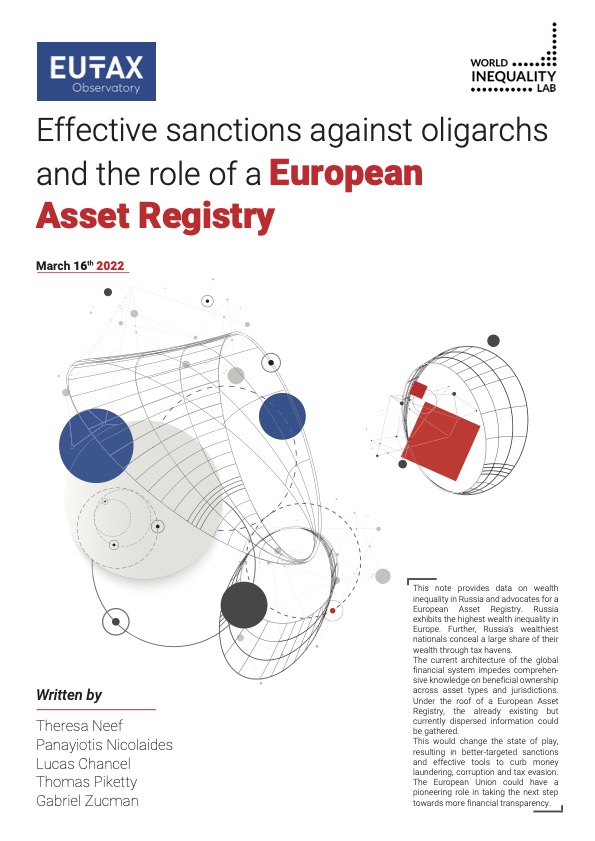
Cette note porte sur les inégalités de patrimoine en Russie et plaide en faveur d'un registre européen des actifs. Un tel registre permettrait de cibler les sanctions et de disposer d'outils efficaces pour lutter contre le blanchiment d'argent et l'évasion fiscale.
Par
Eloi Flamant, Sarah Godar, and Gaspard Richard
Ce rapport fournit une analyse empirique de la concurrence fiscale entre les particuliers et les entreprises au sein de l’Union européenne, au travers d'un classement des régimes fiscaux les plus néfastes. Il propose également plusieurs options pour faire face à ces tendances.
Par
Mona Barake, Theresa Neef, Paul-Emmanuel Chouc, and Gabriel Zucman
En octobre 2021, 136 pays et juridictions ont convenu de la mise en œuvre rapide d'une réforme majeure du système international d'imposition des sociétés. Dans cette note, nous présentons des simulations des effets sur les recettes de l'impôt minimum mondial de 15 % prévu par cet accord.
Pour bien comprendre l'importance des Pandora Papers, il est utile de les mettre en perspective, sur la base des recherches économiques les plus récentes, les efforts internationaux en place afin de réduire la fraude extraterritoriale, et les pistes futures pour parvenir à la transparence fiscale.
Par
Giulia Aliprandi, Mona Barake, and Paul-Emmanuel Chouc
Les principales banques européennes comptabilisent chaque année 20 milliards d'euros (soit 14 % de leurs bénéfices totaux) dans les paradis fiscaux. Ce pourcentage est stable depuis 2014.
Par
Mona Barake, Theresa Neef, Paul-Emmanuel Chouc, and Gabriel Zucman
132 pays ont convenu d'un taux d'imposition minimal d'au moins 15 % sur les bénéfices de leurs multinationales. Cependant, la déclaration commune comprend une disposition qui pourrait réduire considérablement l'efficacité de cette politique : l'exemption des exemptions fondées sur la substance.